DEX vs CEX: How They Differ and Which to Use
Compare decentralized and centralized crypto exchanges: custody models, order matching engines, gas vs trading fees, KYC requirements, and selection rules.
On this page
Quick read
Centralized Exchanges (CEXs) and Decentralized Exchanges (DEXs) are the two primary gateways for buying and trading cryptocurrency. This explainer breaks down the fundamental differences between custodial order books and self-custodial liquidity pools, comparing asset safety, transaction fees, speed, privacy, and when to use each venue type.
What to remember
- CEXs hold your funds in centralized exchange accounts; DEXs execute trades directly from your non-custodial wallet.
- CEXs use off-chain matching engines for instant order execution; DEXs rely on on-chain smart contracts or Automated Market Makers (AMMs).
- CEX trading fees are percentage-based commissions (maker/taker); DEX costs include network gas fees, LP fees, and slippage.
- CEXs require identity verification (KYC) and fiat bank integration; DEXs are permissionless and accessible globally with just a wallet.
- Use a CEX for fiat on-ramping and high-speed trading; use a DEX for unlisted tokens, self-custody security, and permissionless swaps.
When trading crypto, choosing between a Centralized Exchange (CEX) like Coinbase or Binance and a Decentralized Exchange (DEX) like Uniswap or Raydium is one of the first major decisions you will make.
While both venues allow you to swap one asset for another, their underlying technology, custody architecture, and risk profiles are completely different.
1. Asset Custody: Who Holds the Keys?
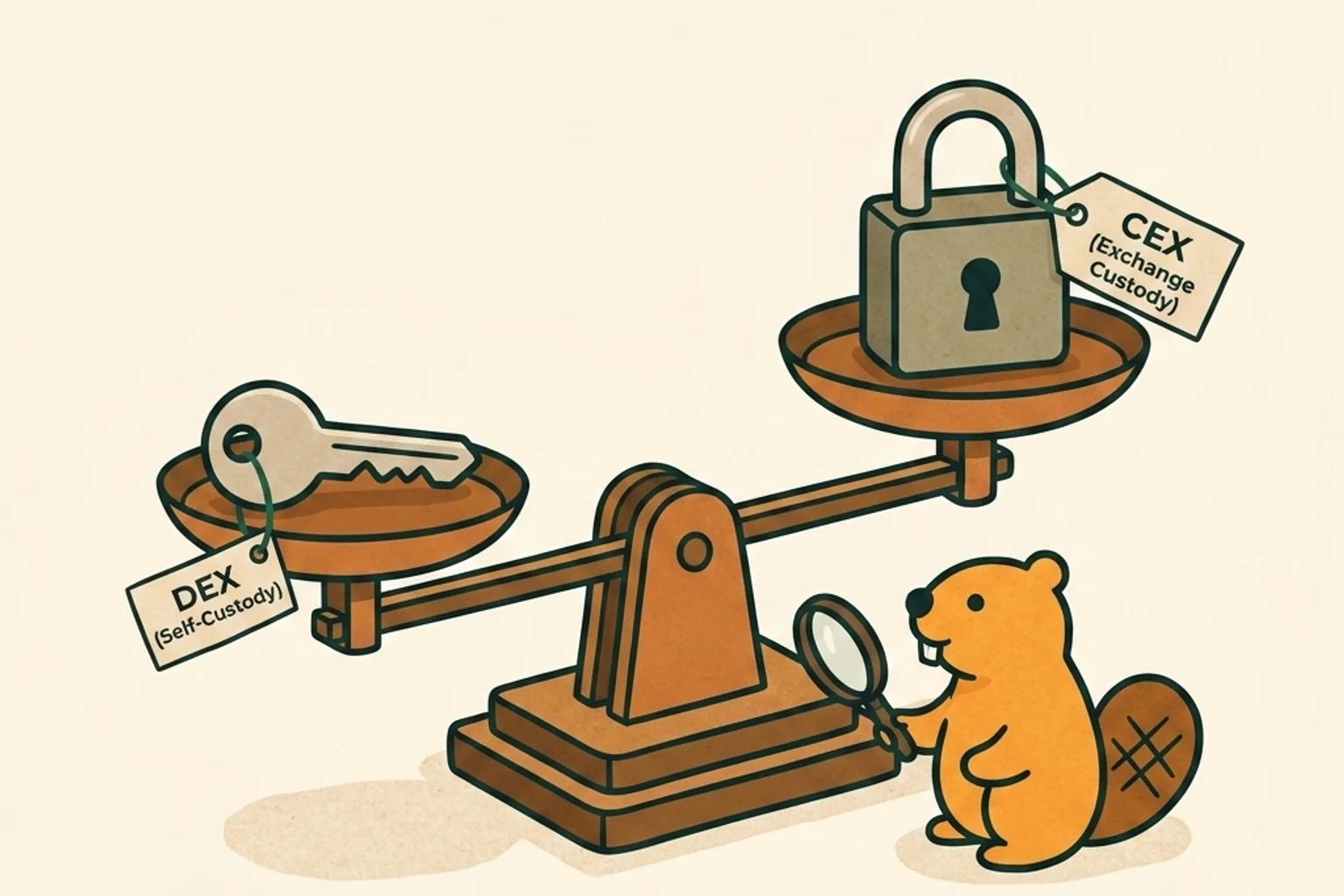
The single defining distinction between a CEX and a DEX is asset control.
- Centralized Exchanges (CEX): When you deposit funds to a CEX, the exchange holds the private keys to your crypto in its corporate vault. Your account balance is tracked internally on the exchange's private database.
- Decentralized Exchanges (DEX): A DEX never takes custody of your funds. You connect a (such as Rabby, MetaMask, or a hardware wallet), and every trade executes as a signed transaction directly on the blockchain ledger.
2. Order Execution: Order Books vs. AMM Pools
How orders are filled differs drastically between platforms:
Centralized Order Books (CEX)
CEXs run off-chain matching engines capable of processing millions of transactions per second. Buyers place bid limit orders and sellers place ask limit orders on a central . Trades execute in milliseconds when bids match asks.
Automated Market Makers & On-Chain Books (DEX)
Most DEXs do not rely on traditional buyers and sellers matching orders in real time. Instead, they use :
- Trades execute against smart contract liquidity pools based on mathematical pricing formulas.
- Modern DEXs on high-throughput chains (like Hyperliquid or dYdX) offer on-chain order books, but execution remains tied to blockchain block times and validator consensus.
3. Cost Structure: Commissions vs. Gas Fees
The cost of trading on a CEX versus a DEX depends heavily on trade size and network congestion:
| Cost Factor | Centralized Exchange (CEX) | Decentralized Exchange (DEX) |
|---|---|---|
| Trading Fee | 0.05% – 0.50% (Maker / Taker commission) | 0.01% – 1.00%+ (Liquidity Provider fee tier) |
| Network Cost | Free off-chain matching (withdrawal fee applies) | Blockchain Gas Fee (Paid in ETH, SOL, etc.) |
| Slippage Risk | Low on major pairs | Higher on low-liquidity AMM pools |
| Deposit / Withdrawal | Standard bank transfer / wire fees | On-chain gas fee per transfer |
On a CEX, trading a $10 position costs a few cents in percentage fees. On Ethereum mainnet, swapping the same $10 on a DEX might cost $15 in network gas, making small trades on congested Layer 1 networks uneconomical.
4. Asset Selection and Verification
- CEX Listings: Centralized exchanges curate listed assets through legal compliance and liquidity vetting. New tokens often take months or years to get listed on top-tier CEXs.
- DEX Listings: Anyone can deploy a token contract and create a DEX liquidity pool in minutes. This makes DEXs the birthground for early-stage projects, memecoins, and decentralized governance tokens—but also increases exposure to unvetted "rug pull" scams.
Technical Parameter Comparison
| Category | Centralized Exchange (CEX) | Decentralized Exchange (DEX) |
|---|---|---|
| User Registration | KYC / Passport / Proof of Address | No registration (Connect Web3 Wallet) |
| Fiat Support | Direct USD/EUR bank deposits & card buys | No direct fiat rails (Crypto-to-crypto only) |
| Execution Speed | Sub-millisecond (Off-chain engine) | 1–12 seconds (Dependent on block time) |
| Order Types | Market, Limit, Stop-Loss, OCO, Trailing | Market & Limit (Advanced orders via keepers) |
| Security Threat | Exchange Hacking / Insolvency / Seizure | Smart Contract Exploits / Phishing Attacks |
5. Conclusion: Choosing the Right Exchange Architecture
Neither exchange model is universally superior; CEXs and DEXs excel at fundamentally different tasks. Most active investors use both environment types strategically based on their immediate goals:
- Use a CEX when you need to: On-ramp fiat currency directly from a bank account, execute high-frequency limit orders, or trade small dollar amounts without paying gas fees.
- Use a DEX when you need to: Maintain total self-custody over your assets, trade permissionlessly without identity verification, or access early-stage tokens long before they hit centralized exchanges.
By understanding the distinct security trade-offs—exchange insolvency risk on CEXs versus smart contract and self-custody risk on DEXs—you can choose the safest, most cost-effective venue for every transaction.
Frequently Asked Questions
It depends on the network and trade size. On low-cost Layer 2 networks (like Arbitrum or Base) or Solana, DEX gas fees cost less than $0.05 per swap. On Ethereum Layer 1 during high congestion, gas fees can exceed $20, making CEXs cheaper for small trades.
Not directly. DEXs operate entirely on-chain using cryptocurrency. To trade on a DEX, you must first acquire crypto (like ETH or USDC) from a CEX or third-party fiat gateway and transfer it to your Web3 wallet.
A non-custodial wallet connected to a DEX is safer from counterparty insolvency because you control the private keys. However, you assume full responsibility for protecting your seed phrase and avoiding phishing scams.
On open-source, immutable smart contract DEXs (like Uniswap on Ethereum), funds cannot be frozen because liquidity resides in non-custodial contracts accessed via your private keys. However, note two key caveats: (1) Centralized frontend websites can block IP addresses or censor wallet addresses (though users can still interact via block explorers), and (2) App-chain DEXs (operating on custom, closed-source chains) or DEXs with centralized admin multisigs and pause functions CAN freeze state or halt withdrawals.
Centralized exchanges aggregate deep institutional liquidity through order books. Automated Market Maker (AMM) DEXs calculate prices algorithmically based on the current ratio of tokens in a liquidity pool (x × y = k). Executing a very large order relative to pool depth heavily skews the ratio, causing steep price impact.
No. Standard decentralized exchanges require no user registration, passport uploads, or email verification. You simply connect a Web3 wallet to trade permissionlessly. However, third-party fiat on-ramp gateways embedded in wallet apps do require standard KYC verification.
If a CEX goes bankrupt (like FTX), user deposits held in exchange master wallets become entangled in bankruptcy court, often freezing funds for years. If a DEX development company shuts down, its smart contracts continue operating on the blockchain indefinitely, allowing users to withdraw liquidity anytime.
Sources and further reading
Primary studies and documentation for exchange venues:
- Bank for International Settlements (BIS) — Decentralized vs Centralized Exchange Liquidity Study
- Uniswap Docs — AMM Protocol Mechanics
This article is educational. It is not trading advice, and exchange availability, fee schedules, and regulatory rules vary by jurisdiction.
Keep learning
Recommended next reads based on this lesson.
- How Exchanges Build the Index Price: The Basket Behind Your LiquidationEvery venue builds its index from its own basket of spot exchanges, with its own rule for what to do when one of them dislocates. Work through the published methodologies at Binance, Bybit, OKX and Deribit, and see why the same position carries a different liquidation price on each.
- How to Read a Crypto Order BookBid and ask structure, depth charts, walking a large order through the book level by level, why walls are claims rather than commitments, and the statutory definition of spoofing.
- How AMMs Work: Uniswap, Curve, and the Math UnderneathUnderstand Automated Market Makers: the constant product formula (x × y = k), price impact, Curve Stableswap invariants, and Uniswap v3 concentrated liquidity.
- Crypto Slippage Explained: How It Works and When It HurtsUnderstand the difference between price impact and slippage, how order book depth affects execution prices, DEX slippage tolerance, and practical ways to minimize trading losses.