How to choose a bitcoin wallet
The four ways to hold bitcoin keys — custodial, hot, hardware, and multisig — and a single test for deciding which one your holdings actually need.
On this page
What are you actually choosing when you choose a wallet?
Your bitcoin is not in your phone, and it is not in a hardware device. It is on the blockchain, and it stays there.
What a wallet holds is a — the thing that decides who is allowed to spend this. That reframes the whole decision. You are not choosing where to put your coins, because they never move off the network. You are choosing who keeps the key.
If the idea that a wallet stores keys rather than coins is new to you, the mechanics behind it are worth reading first in who actually holds your crypto.
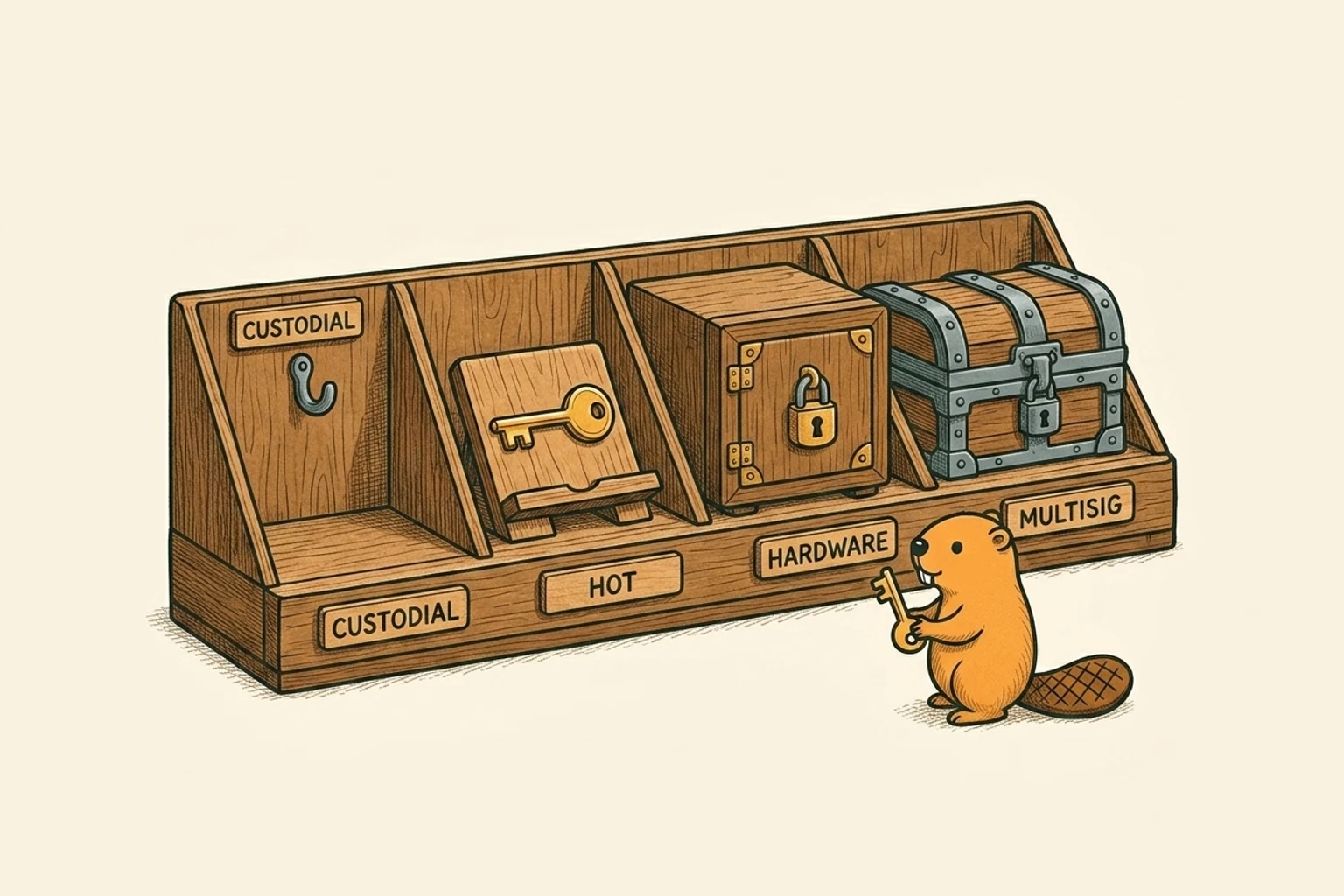
What are the four ways to hold bitcoin?
1. Custodial — the platform keeps the key
Who holds the key: an exchange or a fund company. You hold an account and a password.
What you get: the least to manage. Forgotten passwords are recoverable through the platform's identity process, buying and selling are easy, and there is no backup for you to lose.
What you carry instead: if the platform fails, is breached, or freezes your account, you have no way to act on your own. Your balance is a claim on a company rather than an asset you control, and it does not carry the deposit protection a bank balance does.
Examples: exchanges such as Coinbase and Kraken. Spot bitcoin ETFs follow the same structure — a custodian holds the coins and you hold a security that tracks them.
2. Hot wallet — you keep the key, on a connected device
Who holds the key: you, but stored on a phone or computer that is online.
What you get: the coins are genuinely yours, you can send at any time, and you can connect to on-chain applications.
What you carry instead: a compromised device, a phishing link, or a malicious app can take the key. Transfers are irreversible, so a successful theft is final — there is nobody to reverse the payment.
Examples: BlueWallet and Electrum for bitcoin; MetaMask and Phantom on other chains.
3. Hardware wallet — you keep the key, offline
Who holds the key: you, on a dedicated device that never connects to the internet. The signing happens inside the device, so the key itself is never exposed to the computer you plug it into.
What you get: malware on your laptop cannot extract a key that has never been on the laptop. This is the standard arrangement for holdings kept over long horizons.
What you carry instead: the device costs money, and it must be bought directly from the manufacturer — tampered devices resold through third-party listings are a known attack. And the responsibility is entirely yours: if the recovery phrase is lost, nobody can reissue it.
Examples: Ledger, Trezor, Coldcard.
4. Multisig — the key is split into several
Who holds the key: nobody holds all of it. It is split into separate keys kept in different places, and spending requires a set number of them — a two-of-three arrangement is the common starting point.
What you get: no single point of failure. One key lost or one key stolen does not move the coins. It also makes inheritance planning tractable, because a key can be placed with a third party without giving them control.
What you carry instead: setup and maintenance are genuinely harder, and misconfiguration is the main risk for newcomers — a badly recorded setup can lock you out just as effectively as a theft.
Examples: Sparrow Wallet for a self-managed setup; Casa and Unchained for collaborative custody services.
| Arrangement | Who holds the key | Main risk you carry | Effort to run |
|---|---|---|---|
| Custodial | The platform | The company fails, is breached, or freezes the account | None |
| Hot wallet | You, on a connected device | Malware or phishing takes the key | Low |
| Hardware wallet | You, on an offline device | You lose the backup, or buy a tampered device | Moderate |
| Multisig | You, split across locations | You misconfigure it, or lose track of the setup | High |
Notice that the risk column never empties — it only changes shape. Moving from custodial to self-custody does not remove danger, it swaps counterparty failure for personal responsibility. That is the trade being made at every step down the table.
Which one fits how much you hold?
Do not try to remember the four names. Remember one test instead.
That line is the whole decision. Everything else is detail.
| Your situation | What fits | Why |
|---|---|---|
| A small amount, still learning | Leave it on the exchange | The most likely loss at this size is your own mistake, not the platform's failure. |
| Small everyday balances, using on-chain apps | A mobile hot wallet | You need speed and connectivity, and the amount at risk is bounded. |
| Long-term holdings, a meaningful sum | A hardware wallet | The exposure is now measured in years, which is a different proposition from a week. |
| An amount that would change your circumstances | Multisig, or collaborative custody | No single lost or stolen key should be able to end the position. |
| You want the price exposure without handling keys | A spot bitcoin ETF | It is custodial by design — you are accepting platform risk deliberately in exchange for not managing a key. |
Once you have decided who holds the key, the remaining question is where that key physically lives, and the online-versus-offline trade-off is covered in detail in hot wallet vs cold wallet.
Frequently asked questions
There is no single safest option, because the arrangements fail in different ways. A hardware wallet is the standard choice for long-term holdings because the key never touches an internet-connected machine. For amounts large enough to change your circumstances, a multisig setup is stronger still, since no single lost or stolen key can move the funds.
It is reasonable for small amounts you are actively trading, and it removes the risk of you losing a backup. What it adds is exposure to that company — insolvency, a breach, or a frozen account are all outcomes you cannot act against. Crypto held with an exchange generally carries no government deposit protection, so the size of the balance is what should drive this decision.
Usually not. If losing the amount would be an inconvenience rather than a serious setback, the cost and the backup responsibility of a hardware device outweigh what it protects. The point at which this flips is when a total loss would genuinely hurt, and that is the moment to move rather than a fixed sum that applies to everyone.
Multisig splits control across several keys and requires a set number of them to spend — commonly two of three. It removes the single point of failure that every other arrangement has, so one lost or stolen key is survivable. It suits large long-term holdings and inheritance planning, and it is a poor fit for beginners because misconfiguration can lock you out permanently.
No, provided your recovery phrase is intact. The device stores the key, but the phrase regenerates it on a replacement device from any manufacturer that follows the same standard. This is why the phrase, not the device, is the thing that must be backed up carefully — and why a lost phrase is unrecoverable even when the device still works.
Only from the manufacturer's own website, or an official reseller they list. Devices bought through third-party marketplace listings have been tampered with in real cases, arriving with a pre-generated recovery phrase so the seller can drain the wallet later. The discount on a resold device is never worth the risk it introduces.
No. An ETF gives you exposure to the price through a security, while a custodian holds the underlying coins. You never hold a key, which means you cannot send bitcoin, and you are accepting the fund and custodian structure as a counterparty. It suits someone who wants price exposure inside a brokerage account and does not want to manage keys at all.
Yes, and most people eventually do. A common arrangement is a small spending balance in a hot wallet or on an exchange for convenience, with the bulk of long-term holdings on hardware. Splitting this way means a compromise of the convenient tier is a bounded loss rather than everything.
With any self-custody wallet, the funds become permanently unreachable. No support desk can restore it, because nobody else ever held it and there is no account to reset. The balance stays recorded on the network, but nobody can produce the signature required to move it — which is the reason to test a backup before relying on it.
Related coins

Keep learning
Recommended next reads based on this lesson.
- Who actually holds your crypto?Learn what a crypto wallet really stores, the difference between custodial and self-custody holdings, and what each arrangement means when something goes wrong.
- Hot Wallet vs. Cold Wallet: Security, Trade-Offs, and How to Store Your CryptoCompare hot vs. cold crypto wallets, understand private key self-custody, examine security trade-offs, and implement a multi-tier storage strategy.
- Crypto Treasury Companies: What You Own and What Makes Them SellHow digital asset treasury companies finance their coin purchases, who ranks ahead of common shareholders, why the buying stops, and what forces a sale.
- Zcash vs Monero: Optional Privacy, Mandatory Privacy, and What Each One CostsZEC and XMR disagree about who has to be private. Compare shielding models, ring signatures against zero-knowledge proofs, the 2026 Orchard bug and Ironwood upgrade, Monero's pending FCMP++, exchange access, and the EU rule that lands in July 2027.