Who actually holds your crypto?
Learn what a crypto wallet really stores, the difference between custodial and self-custody holdings, and what each arrangement means when something goes wrong.
On this page
Quick read
A wallet does not contain coins — it holds the keys that authorize transfers recorded on a network. This lesson explains what that means for ownership, how custodial and self-custody arrangements differ, and which failure each one exposes you to before you decide where to keep anything.
What to remember
- Balances live on the network, not in your wallet — a wallet holds the keys that authorize moving them.
- Custody is the question of who controls those keys, and it is separate from which device or app you use.
- With a custodian you hold a claim on a company; with self-custody you hold the asset and the entire responsibility for the key.
- Each arrangement removes one failure and introduces another, so the useful question is which failure you are better placed to survive.
What does a wallet actually store?
The word "wallet" is misleading, and the confusion it causes is the reason this lesson exists. A physical wallet contains your money. A crypto wallet does not contain your crypto.
Balances exist as entries in a network's shared history — the record every participant validates. Nothing is transferred into an app or a device. What a wallet actually stores is a : the secret that produces the signature the network requires before it will accept a transfer from a given address.
That single fact reframes everything else. Ownership on a blockchain is not possession of an object. It is the ability to produce a valid signature. The practical question is never "where are my coins" but "who can sign for them".
What are the two arrangements?
Everything reduces to who holds the key. There are two answers, and the industry shorthand for them is worth learning.
| Question | Custodial (a platform holds the key) | Self-custody (you hold the key) |
|---|---|---|
| What do you actually have? | A claim on a company that owes you a balance. | The asset itself, controlled by a key only you hold. |
| Who can move the funds? | The platform, on your instruction and subject to its policies. | Whoever holds the key — which should only be you. |
| If you lose your password? | Recoverable through the platform's identity process. | Nothing to recover unless you have your own backup. |
| If the holder fails? | Your balance is exposed to the company's solvency and conduct. | Unaffected — no third party sits between you and the network. |
| Can access be frozen? | Yes. Accounts can be restricted, suspended, or subject to withdrawal limits. | No party can block a valid transfer you sign. |
Notice that neither column is uniformly better. Custody removes the risk of you losing a key and replaces it with the risk of a company failing you. Self-custody removes the company and hands you a responsibility with no undo. The phrase people use for this is not your keys, not your coins — accurate as far as it goes, though it tends to be quoted as if self-custody were free of downside, which it very much is not.
What is a recovery phrase, and why does it matter so much?
When you set up a self-custody wallet, it will show you a sequence of words — commonly twelve or twenty-four — and ask you to write them down. This is the , and it is not a password. It is a portable form of the keys themselves.
Two consequences follow, and they are absolute:
Steps
Anyone who reads it owns the funds
The phrase alone reconstructs the wallet on any device, with no additional check. There is no second factor behind it and no account to lock.
Anyone who loses it loses the funds
No support desk can reissue it, because nobody else ever had it. A lost phrase with no backup means the balance stays on the network permanently unreachable.
This is why every legitimate wallet tells you to record the phrase offline and never enter it anywhere. It is also why the single most common theft technique is simply asking for it — through a fake support account, a cloned website, or an app that offers to "validate" or "sync" your wallet.
What does custodial risk actually look like?
"The platform holds it" sounds administrative until you separate the distinct ways it can go wrong. These are different failures, not one:
- Solvency. If the company becomes insolvent, customer balances may be treated as claims in a bankruptcy process rather than as property held for you. Whether they are segregated depends on the platform's structure and jurisdiction, and it is rarely obvious from the interface.
- Access. Accounts can be restricted for compliance review, suspected fraud, or regulatory reasons. Withdrawal limits and pauses are ordinary operational tools, and they apply exactly when many users want to leave.
- Operational failure. Platforms have lost customer assets to security breaches and to internal mishandling.
- Jurisdiction. Which entity actually holds your balance, and under which country's rules, determines what protections exist. Crypto balances generally do not carry the deposit insurance that bank accounts do.
So which should you use?
The honest answer is that this is a matching problem, not a ranking. The question worth asking is which failure you are actually equipped to survive.
Someone buying a small amount, trading regularly, and unlikely to maintain a secure offline backup is often better served by a reputable custodian — platform risk is real, but so is the risk of losing a phrase, and for small balances the second is more likely. Someone holding an amount they would be seriously harmed to lose, over a long horizon, has a much stronger case for self-custody, because concentrated platform exposure over years is a different proposition from a week.
Most people end up splitting: a working balance where it is convenient, and long-term holdings under their own key.
Once you have decided who holds the key, the separate question is where to keep it — on an internet-connected device or on hardware kept offline. That trade-off is covered in Hot wallet vs cold wallet.
Conclusion
A wallet holds keys, not coins. Balances stay on the network, and what you actually control is the ability to produce the signature that authorizes moving them. Every custody question follows from that: ownership is the capacity to sign, so whoever can sign is, in practice, the owner.
That produces two arrangements with genuinely different failure modes. A custodian removes the burden of key management, gives you a password reset, and in exchange makes your balance a claim on a company — exposed to its solvency, its access controls, and its jurisdiction, generally without the deposit protection a bank balance carries. Self-custody removes the company entirely and hands you a responsibility with no recovery path, where a recovery phrase read by anyone else is a total loss and a phrase lost by you is equally final.
Neither is the safe option in the abstract, and treating either as obviously correct is how people get hurt. Match the arrangement to the amount and the time horizon: convenience where a loss would be an inconvenience, your own key where a loss would be serious. Whatever you choose, take the two precautions that apply in every case — never disclose a recovery phrase to anyone for any stated reason, and test a backup by restoring from it before you depend on it.
Frequently asked questions
On the network, as entries in the shared history that participants validate. Nothing moves into your wallet app or device. What your wallet stores is the private key that lets you authorize transfers from your address, which is why the meaningful question is who can sign rather than where the coins sit.
It is a question of who holds the private key. With a custodial arrangement a platform holds it and you hold a claim on that company. With self-custody you hold the key yourself, which means you hold the asset directly and also carry the entire responsibility for keeping the key safe and backed up.
That if someone else controls the private key, they control the asset and you hold a promise rather than the thing itself. It is accurate, but it is often quoted as though self-custody had no downside. Self-custody removes counterparty risk and replaces it with irreversible personal responsibility for the key.
With self-custody, the funds become permanently unreachable. No support desk can restore the phrase because nobody else ever held it, and there is no account to reset. The balance remains recorded on the network but nobody can produce the signature needed to move it.
Yes, completely and immediately. The phrase reconstructs your wallet on any device with no further verification, so anyone who reads it can move everything. This is why no legitimate service ever asks for it, and why any request for it — however official it looks — is a theft attempt.
Generally not in the way a bank balance is. Crypto holdings typically do not carry government deposit protection. Some platforms hold private insurance covering specific scenarios such as a breach of their own systems, which is narrower than it sounds and does not usually cover the platform failing or your account being compromised.
Neither is safer in general, because they fail differently. An exchange exposes you to that company's solvency, access controls, and jurisdiction. Your own wallet removes those but makes a lost or stolen key final. Match the choice to the amount and time horizon: convenience for small working balances, self-custody for holdings you could not afford to lose.
Yes. Accounts can be restricted for compliance review, suspected fraud, or regulatory reasons, and withdrawal limits or pauses are standard operational tools. This is a normal feature of custodial arrangements rather than an unusual event, and it tends to matter most when many users want to withdraw at once.
No. Self-custody means you hold the key; hardware is one way to store it. A software wallet on a phone or computer is still self-custody. Hardware keeps the key on a device that stays offline, which reduces exposure to malware and is worth considering as the amount grows.
Related coins


Keep learning
Recommended next reads based on this lesson.
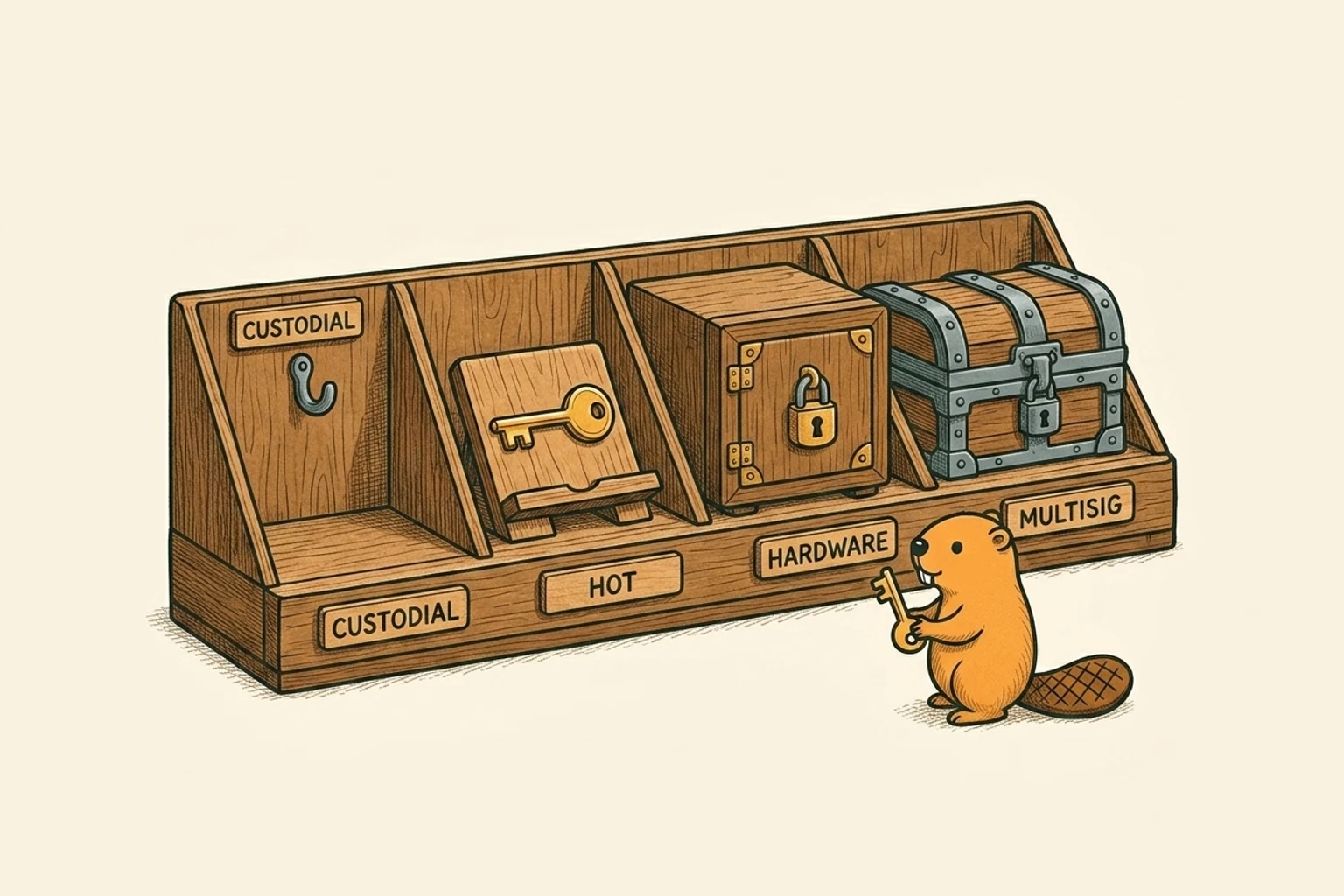
- How to choose a bitcoin walletThe four ways to hold bitcoin keys — custodial, hot, hardware, and multisig — and a single test for deciding which one your holdings actually need.
- What is a stablecoin?Learn what a stablecoin is, how fiat-backed, crypto-backed, and algorithmic designs try to hold a peg, and which risks a stable price does not remove.
- How Exchanges Build the Index Price: The Basket Behind Your LiquidationEvery venue builds its index from its own basket of spot exchanges, with its own rule for what to do when one of them dislocates. Work through the published methodologies at Binance, Bybit, OKX and Deribit, and see why the same position carries a different liquidation price on each.
- What "Beta" Actually Means in Crypto (And Why Most Portfolios Are All Beta)Beta gets used three incompatible ways in the same conversation. Work through the real definition, why the benchmark is contested when Bitcoin is 56% of it, why crypto beta will not hold still, and why a ten-coin basket is closer to a leverage decision than a diversification one.