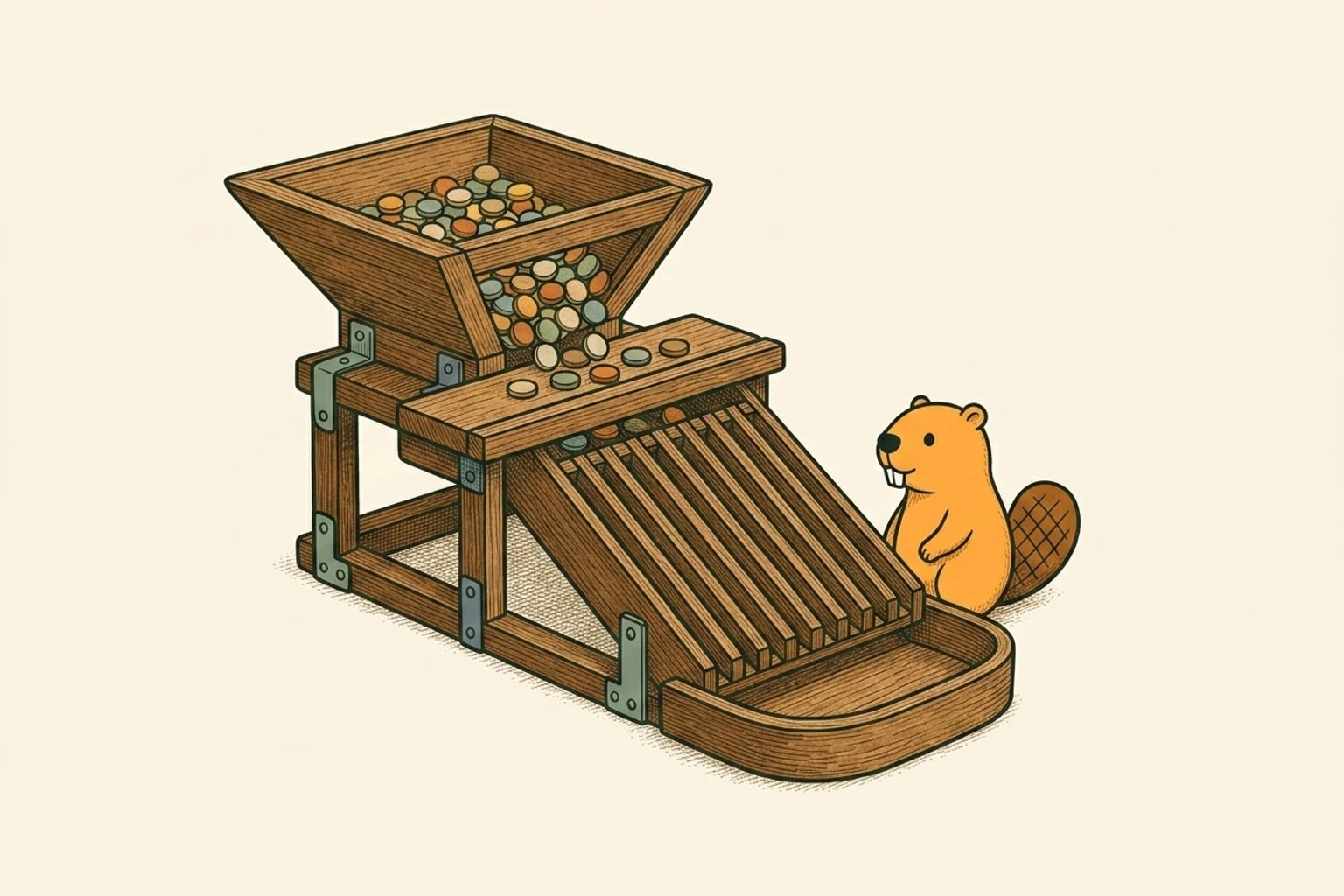
What Is a Token Launchpad? pons and Pump.fun Compared
How token launchpads solve the cold-start problem, how pons and Pump.fun price a new token differently, and what graduation does and does not signal.
On this page
- The cold-start problem every new token has
- Two ways to open a market
- How pons works
- How Pump.fun works
- pons and Pump.fun compared
- What graduation does and does not mean
- The risks a launchpad does not remove
- How to check a launch before you buy
- Where to watch the PONS token
- Conclusion
- Frequently asked questions
Quick read
A token launchpad lets anyone create a tradable token and open a market for it in a single transaction. This lesson explains the cold-start problem launchpads solve, how pons and Pump.fun do it differently, and what graduation actually tells you about a new token.
What to remember
- A launchpad's core job is the cold-start problem: giving a brand-new token a price and a way to trade before anyone has provided liquidity.
- pons v1 opens a locked Uniswap V3 pool in the launch transaction; Pump.fun and pons v2 start on a bonding curve that graduates into a pool.
- Graduation is a threshold event, not a quality signal. It confirms the curve sold out or the paired target was met, and nothing more.
- Locked liquidity removes the creator's ability to pull the pool, but it does not remove concentration, thin markets, or loss of value.
- Verify the token contract address before trading. Names and symbols are not unique on any permissionless launchpad.
The cold-start problem every new token has
A newly created token has no price, no liquidity, and no counterparty. Nothing about the token itself tells you what it is worth, and even a buyer who wants it has no one to buy from. That is the cold-start problem, and it is the reason most token ideas never become markets.
A token launchpad exists to collapse that gap into one transaction. Instead of asking a creator to deploy a contract, initialise a pool, deposit liquidity, and lock it across several steps — each of which can fail or be front-run — the launchpad bundles the whole sequence. The creator picks a name, a ticker, an image, and a fee wallet, and the platform does the rest.
That is the product. Everything else about a launchpad is a design choice about how the new market gets its first price, which is where launchpads differ sharply. The mechanics of a live pool are covered in what an automated market maker does; this lesson is about how a token reaches one.
Two ways to open a market
Almost every launchpad uses one of two approaches. They produce very different trading experiences.
An instant pool
The first approach deploys the token and its liquidity pool in the same transaction. The token has a live, quotable market from the first block, and price discovery happens the way it does on any exchange pool: buyers and sellers trade against real reserves, and the price moves with each trade.
Because the market exists immediately, the launch needs protection against the first few seconds. A bot watching for new pools can buy the opening before anyone else and sell into the crowd that follows. Launchpads answer this with opening limits or a short-lived buy tax.
A bonding curve
The second approach does not open a pool first. It mints the whole supply into a bonding curve, a deterministic pricing function that holds the supply and is always willing to buy or sell against it. The price is not set by an order book or a market maker; it is computed from how much of the supply has been bought.
The curve solves the cold-start problem differently: there is always a counterparty, and the quoted price is honest because it is just the curve's arithmetic. The trade-off is that early buyers pay a lower price only because they are earlier, and the curve gets steeper as supply is bought up, so large orders move the price sharply.
How pons works
pons is a non-custodial launch and trading interface on Robinhood Chain. Every launch and trade is a transaction your own wallet signs, and pons never holds user funds. The product and its older documentation describe two live generations — v1 and v2 — and both remain on-chain.
pons v1: one transaction, one locked pool
In the v1 model, a launch deploys the token and its WETH pool in a single transaction and locks the position automatically. Each launch uses a fixed supply of one billion tokens, a 1% pool fee, and a 0.0005 ETH launch fee, and tokens trade against WETH only. There is no bonding curve and no later migration: buys and sells run in the same Uniswap V3 pool from the first block.
A v1 launch "graduates" once the WETH paired in its locked pool reaches a threshold — the documented default is 4.2 ETH. Graduation is a status marker, not a migration. Trading continues in the same pool, and pons states plainly that reaching the threshold "is not a quality signal and does not guarantee future liquidity, price, or an exit."
Opening protection lasts the first two blocks. On the launch block, only the creator's initial buy can execute; for the rest of the window each wallet can hold at most 5% of supply and buy at most 5.5%. Selling and wallet-to-wallet transfers are never restricted, and the limits end when the window closes.
pons v2: a curve that graduates into a locked Uniswap v4 pool
The v2 model changes the opening. The full supply mints to a constant-product bonding curve, and once the curve sells out the launch graduates into a Uniswap v4 pool whose liquidity is locked permanently. The pool is created only at graduation, seeded from what the curve collected, so there is nothing to snipe before the curve opens and no separate migration step for the creator to get wrong.
Two details are worth separating from the hype. First, the launch can be priced in native ETH or in another token pons has approved, including a tokenised stock; if it is, that token becomes the currency of the whole launch, and the launch carries that asset's risk on top of its own. Second, opening buys pay a snipe tax that starts at 99% and decays exponentially to zero over the first five seconds. The tax applies only to buys, and what it collects joins the launch's trading fee rather than being burned.
Creators control very little once a launch is live. They can redirect where their fees go and turn an optional buyback on or off. There is no mint, no freeze or blacklist, and no way to raise a tax after launch. Buybacks are not burned either: bought-back tokens are locked in a vault and released gradually over five years. pons notes that public launching on v2 is currently closed and that a creator should read the factory's canLaunch check before offering a create flow.
How Pump.fun works
Pump.fun applies the bonding-curve approach on Solana. Its documentation states that every coin launched on the platform starts on a bonding curve, a constant-product market that quotes a buy and sell price from two virtual reserves. There is no order book and no market maker, so every buy moves the price up, every sell moves it down, and the price you pay is a pure function of how many tokens are in circulation.
When a coin's market capitalisation on the curve reaches a fixed graduation threshold, the curve closes and the entire liquidity pool is migrated atomically to PumpSwap, Pump.fun's own AMM. From that point the coin trades on PumpSwap's liquidity instead. Pump.fun describes graduation as automatic and irreversible, with no human step, and states that the pool is owned by the protocol.
The bonding curve charges a 1.25% total trading fee, split between the coin's creator and the protocol. For a Solana-native comparison, see why Solana is an independent Layer 1.
pons and Pump.fun compared
Both platforms remove the technical work of launching a token. The difference is the mechanism, and the mechanism determines when you can sell, what you are paid in, and what happens at graduation.
| Design point | pons v1 | pons v2 | Pump.fun |
|---|---|---|---|
| Opening mechanism | Token and locked Uniswap V3 pool in one transaction | Full supply minted to a bonding curve | Full supply traded on a bonding curve |
| Opening price | Live pool price from block one | Set by the curve's starting price | Set by the curve's virtual reserves |
| Quote asset | WETH only | Native ETH or an approved token, including tokenised stocks | SOL |
| Graduation | Paired WETH reaches the threshold; trading continues in the same pool | Curve sells out; a new Uniswap v4 pool is seeded | Curve fills; liquidity migrates atomically to PumpSwap |
| Graduated liquidity | Locked Uniswap V3 position | Permanently locked Uniswap v4 position | Pool owned by the protocol |
| Trading fee | 1% pool fee | Curve fee plus an optional creator tax, both capped | 1.25% total fee |
| Creator buyback | Not part of the documented model | Optional and creator-funded; tokens vest over five years | Not part of the documented model |
| Opening protection | Same-block and per-wallet launch limits | 99% buy tax decaying over five seconds | Not documented as a protocol buy tax |
The row that matters most to a trader is the quote asset. On pons v1 and Pump.fun, your entry and exit are denominated in one asset — WETH or SOL — so a position is a bet on the token relative to that asset. On pons v2, a launch can be priced in a tokenised stock, which means the token can rise against the pairing asset while falling in dollar terms, because the pairing asset itself moved. You are taking on two exposures, not one.
What graduation does and does not mean
Graduation sounds like validation. It is not. In every model above it is a mechanical threshold: the curve sold out, or the paired principal reached a configured target. pons's own documentation is explicit that graduation "only confirms the threshold was reached" and is not a quality signal. Pump.fun's documentation calls its version automatic and irreversible, which is a statement about the process, not the asset.
What graduation does change is where liquidity lives. On Pump.fun and pons v2, trading moves from the curve to a pool. On pons v1, nothing moves at all. Once a graduated pool's liquidity is locked, the creator cannot withdraw it, which is a real improvement over launchpads where the creator holds the LP. But locked liquidity is not deep liquidity, and it is not a floor under the price.
The risks a launchpad does not remove
The mechanics above fix specific failure modes, and it is worth being precise about which ones.
- Liquidity pulls are largely closed off, not eliminated. A permanently locked pool cannot be drained by the creator on a graduated token. But a launch that never graduates, or one on a platform without a lock, can still leave holders unable to exit at a fair price. The general pattern is covered in how crypto rug pulls work.
- Concentration is untouched. Nothing about a curve or a locked pool stops a handful of wallets from holding most of the supply. Holder concentration is one of the few things you can check before buying; memecoin odds covers how thin the survival rate is.
- Copycat names are structural. pons states that names and symbols can be copied and that only the contract address is canonical. This is true of every permissionless launchpad, and it is the single most common way traders buy the wrong token.
- Creator-controlled fees can still be hostile. An optional creator tax is fixed at launch and capped, but a high one is real cost and it is disclosed at creation. Check it before you trade.
- Smart contracts, bridges, and the chain itself can fail. A launchpad does not remove protocol risk, wallet risk, or the risk of trading a market whose liquidity is thin enough that your own exit moves the price. Slippage is covered in why crypto slippage happens.
- The opening seconds are still adversarial. Instant-pool launches add per-wallet limits and block restrictions; curves add a decaying tax. Both are mitigations for sniping, not eliminations of it.
How to check a launch before you buy
The checklist is short, and it applies to any launchpad.
Steps
Verify the contract address
Get it from the platform or the blockchain explorer, not from a social post. Names, tickers, and images can all be copied. The address is the only canonical identifier.
Read the fee and any creator tax
Find the base trading fee and, on a curve launch, the creator tax. Both are fixed at launch and should be disclosed. If you cannot find them, treat that as a reason not to trade.
Check where the launch is in its life
A token on the curve, a token awaiting graduation, and a token already in a locked pool are three different risk profiles with three different places to trade.
Look at who holds the supply
A small number of wallets holding most of the float is the clearest on-chain warning. Holder concentration and churn are measurable before you buy.
Size the position for total loss
Treat the entire position as capital you can lose. The base rate for new launch tokens is failure, not a small drawdown.
Where to watch the PONS token
It helps to separate the platform from the token that carries its name. pons is the launchpad. PONS is a single token associated with the protocol: pons's documentation lists it as a graduated reference token launched through the legacy factory, and it is not a governance token.
PONS is also where the protocol's economics become visible. pons states that protocol buybacks use protocol funds to buy PONS and send it to a burn address, reducing circulating supply, and that a manual buyback currently routes 80% of protocol fees through an automated TWAP. Burning does not guarantee a higher price, and the token is not a claim on the platform's revenue.
None of this makes PONS an official Robinhood product. pons is operated by Pons Labs, LLC, and the token trades on third-party venues. You can track it on CoinBeaver's PONS holder and flow dashboard, which charts holder growth, buyback and burn activity, and whale flow from on-chain data.
Conclusion
A token launchpad is a cold-start machine: it turns an idea with no market into a token with a price in one transaction. The two dominant designs get there differently. An instant pool gives the token a real market from block one and relies on short opening limits to blunt sniping. A bonding curve manufactures a counterparty and a deterministic price, then graduates into a locked pool.
pons runs both models on Robinhood Chain, and Pump.fun runs the curve model on Solana. The questions that decide your outcome are the same on either: what asset are you paid in, where is the liquidity after graduation, who holds the supply, what does the creator keep, and is the address you are buying the one you meant to buy. Graduation answers none of those. It tells you a threshold was crossed, and nothing about whether the token is worth holding.
Frequently asked questions
It is a platform that lets anyone create a token and open a market for it without writing code. It bundles token deployment, liquidity, and pool locking into one flow, so a new token has a tradable price immediately.
pons is the launch and trading platform. PONS is a single token associated with the protocol, documented as a graduated reference token launched through pons's legacy factory. The platform and the token are separate things.
They solve the same problem on different chains and with different mechanics. Pump.fun runs a bonding curve on Solana that graduates into PumpSwap. pons runs on Robinhood Chain and offers both an instant locked Uniswap V3 pool and a bonding curve that graduates into a locked Uniswap v4 pool.
It means a threshold was reached: the bonding curve sold out, or the paired asset in the pool hit a configured target. It is a status change, not a quality rating, and it does not guarantee liquidity or a higher price.
On the models described here, no. pons locks the graduated position and describes no withdrawal path for the creator or the platform. Pump.fun states that the graduated PumpSwap pool is protocol-owned. Locked liquidity still does not guarantee a buyer can exit without moving the price.
Because a launchpad makes supply easy to create and demand hard to create. Most launches attract limited attention and little lasting liquidity, so the price falls once early buyers stop arriving. The concentration of supply in a few wallets makes the decline faster.
It is a temporary fee on buying in the first moments of a launch, designed to make being first unprofitable for bots. pons v2 starts its tax at 99% of a buy and decays to zero over five seconds. It applies only to buys.
By the contract address, not the name, ticker, or logo. Anyone can create a token with an identical name and image. Confirm the address against the platform's own data or a block explorer before you sign a trade.
Related coins


Keep learning
Recommended next reads based on this lesson.
- Memecoin Odds: What Happens to 18.67 Million Token LaunchesThe measured survival and graduation rates, what failure actually looks like, and why social feeds show you only the fraction of a percent that worked.
- StonkFun vs Pump.fun and pons: Why the Quote Asset DecidesHow StonkFun prices new Solana tokens against tokenised stocks, and what that changes versus Pump.fun's SOL curve and pons's WETH pool — plus how to verify STONK's burn from the chain.
- Robinhood Chain, Explained for TradersWhat Robinhood Chain is, how its Stock Tokens differ from equity, why it has no native token, and how to separate the chain from the apps built on it.
- Why the Memecoin Craze HappensAttention as the scarce resource, lottery preference, community as the product, and why knowing the base rate does not change behaviour — the mechanism behind the odds.